A single Geiger-Müller tube does not detect muons. It detects everything. The tube fires on any ionizing event that crosses it, which includes cosmic ray muons from the upper atmosphere, but also gamma rays from terrestrial sources (concrete, granite, bananas), beta particles from nearby radioactive isotopes, alpha particles if any get inside the tube, and electrical noise picked up by the cathode wire. The total background count rate on a typical J305 tube is around 25 to 40 counts per minute (CPM). Maybe one count per minute of that is actually a muon. The rest is everything else.
The problem of picking the muon signal out of this background is called coincidence detection. The trick is so simple it feels like cheating.
The principle
Stack two Geiger tubes vertically, one directly above the other. Wire both of their outputs into an AND gate. The gate fires only when both tubes click within a small time window of each other, typically a few microseconds.
The geometry does the filtering. A muon arrives from above, traveling near the speed of light, and is energetic enough to pass through both tubes essentially instantaneously. Both tubes fire within nanoseconds of each other. The AND gate sees two simultaneous pulses and emits one. We count it as a muon.
By contrast, a gamma ray from the floor or the wall is not energetic enough to pass through the first tube and then through the second one with enough energy to register. Even if it does occasionally trigger both tubes, the odds of two unrelated background events firing within the same microsecond window are extremely low. A typical beta or alpha emission usually only crosses one tube. The AND gate rejects all of these.
The result is a count rate dominated by genuine cosmic ray events. The signal-to-noise improvement is enormous.
Why the coincidence window matters
The width of the AND gate's overlap window is a real engineering parameter. Too narrow and you lose real muon events that arrived a hair off-axis or with slight propagation differences through the two channels of analog electronics. Too wide and you start letting through coincidental background, where two unrelated events happen to fall in the same window.
The math is approachable. If each tube has a single-tube count rate R1 and R2 (counts per second), and the coincidence window is τ seconds wide, then the expected rate of accidental coincidences is approximately 2 × R1 × R2 × τ. For two J305 tubes at 0.5 CPS each (~30 CPM) and a 3 microsecond window, you would expect roughly 0.0000015 accidentals per second. That is one accidental every eight days. The true muon coincidence rate is far higher, around 1 to 4 per minute depending on tube geometry. So the signal completely dominates the noise.
Muon Sortes uses a target window of around 3 to 5 microseconds, set by the BAT54 + RC pulse-stretcher network feeding the 74HC08 AND gate. The schematic detail is in this dev log post.
Why two tubes is not always enough
Two stacked tubes only catch muons traveling on the single axis that connects their centers. If a muon arrives at an angle (and most do; the cosmic ray flux has a cos²(θ) angular distribution favoring vertical), the off-axis muons either miss one of the tubes entirely or pass through them at an awkward geometry that may or may not trigger both.
You can extend the coincidence trick to more tubes for two reasons:
- Higher confidence per event. Three or four tubes in coincidence reduces the accidental rate by another factor (it goes as the product of single-tube rates and the window cubed or to the fourth power). Useful for rare-event physics, less critical for a desk clock.
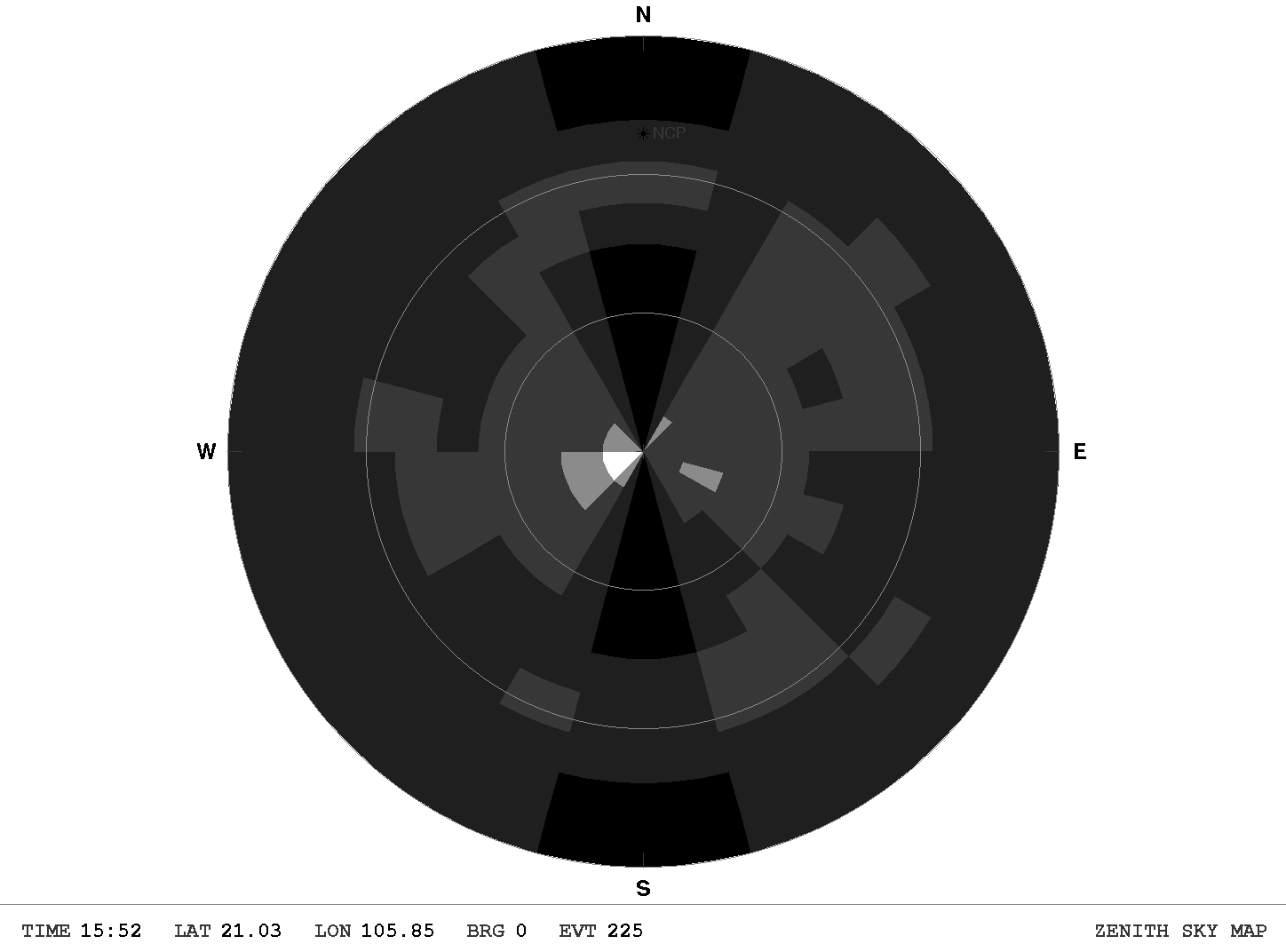
- Multiple detection axes. Four tubes arranged in a tetrahedral or pyramidal pattern give six unique tube pairs, each of which is a different geometric coincidence channel pointing at a different sky direction. This dramatically increases the effective collection area without making the device huge.
Muon Sortes uses four J305 tubes in a fixed pyramidal scaffold. Each of the six pairs gets its own coincidence channel; events are tagged by which axis fired. The total event rate is several times higher than two tubes alone, the user experience is faster, and (more interesting) each axis carries angular information about where in the sky the event came from. The scaffold and tube wiring are in this dev log post.
What still gets through, and how to handle it
No filter is perfect. Three classes of false coincidence still bypass the AND gate:
- Atmospheric showers. A single high-energy cosmic ray can produce a spray of dozens of correlated secondary particles, many of which arrive within a microsecond of each other. These are real cosmic ray events, just not strictly muons. For an RNG application they are equally valid as entropy. For a strict muon counter they are a small contamination.
- Electrical pickup. A nearby switching power supply or a poorly grounded cable can inject a coincident noise pulse into both signal chains simultaneously. The signature is highly periodic, which careful firmware can detect and reject. Muon Sortes wraps the HV input lines in ferrite beads to keep its own switching noise off the signal lines.
- Photons. A bright LED or sunlight leaking into the tube glass can photoelectrically trigger both tubes at once. J305 tubes are sensitive to visible light. The fix is mechanical: wrap each tube in black heat shrink.
For a consumer device, none of these are dealbreakers. They contribute a small known background that is far below the genuine signal rate and that does not bias the RNG in any predictable direction.
Why it matters for a decision clock
A single Geiger tube can produce a fast random number from any radiation source, but the source is unverifiable. Coincidence detection is what lets Muon Sortes truthfully claim that every decision is drawn from a cosmic ray muon, not from background radiation, not from electrical noise, not from anything the user could deliberately influence. The trick that costs an extra IC and a second tube is what makes the experience honest.